




Is lifting more weight the right move?
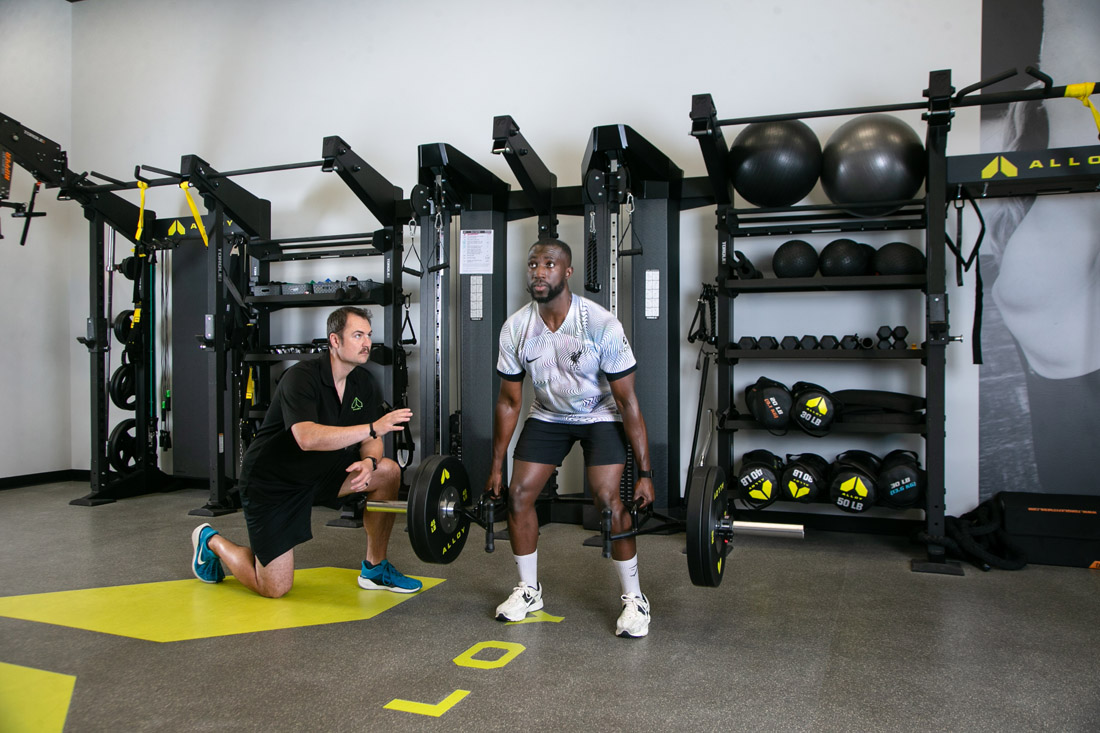
For some people, “lifting weights” conjures images of light dumbbells and high reps. But there’s a meaningful distinction between general strength training and what coaches call heavy lifting, and it can have a powerful impact on how you move, feel and age.
“Heavy lifting is really about driving strength adaptations,” says Danny Hirtler, head coach at Alloy Personal Training in Chastain.
That typically means working at 85-100% of your “one-rep max,” which is the most weight you can lift once, across one to five repetitions per set for three to four sets, with about a three-to five minute rest in between. By contrast, training for muscle size uses lighter loads at around 70-80% of your “max,” higher reps and a much shorter rest in between.
Benefits of Going Heavy
Heavier lifting is linked to increased bone density, better joint stability and a metabolism boost thanks to more lean muscle mass. A strong body helps maintain day-to-day activities, from getting up off the floor to lifting kids for longer, translating to a better quality of life. “If you live to 100, you don’t want the last decade spent in bed,” Hirtler says. “Strength training plays a huge role in longevity. But to get there, it’s going to be hard work in the gym.”
Hirtler recommends a professional assessment with a personal trainer to determine how much weight is right for you or using tools like one-rep max calculators from organizations such as the National Academy of Sports Medicine. “If you feel like you can do six or seven reps, the weight is too light. You should feel like you can’t do the fifth rep.”
The Essential Moves
A well-rounded routine doesn’t need to be complicated. Focus on foundational movement patterns: squats, hip hinges such as deadlifts or glute bridges, upper-body pushing and pulling exercises, lunges, core work and loaded carries. Beginners might start with a goblet squat (holding a dumbbell at the chest). More advanced lifters progress to barbell variations.
First Comes Form
The proper form prevents injury, which is another reason to seek a trainer’s guidance. “If you can’t lift it with good form, it’s too heavy,” Hirtler says. In a squat, for example, knees should track in line with the toes, not cave inward. During a hinge movement, the spine should stay neutral with the back flat, with the motion driven by the hips, not the lower back. Across all lifts, bracing the core helps protect the spine and maintain alignment.
How Often to Lift
As for frequency, three strength sessions per week with active recovery days in between are enough for most people to see results. Younger or more experienced lifters may add a fourth or fifth day, but rest becomes increasingly important with age. Active recovery with light cardio, such as walking, can help reduce soreness and support circulation.
Busting a Myth
One of the biggest misconceptions? Heavy lifting will make women “bulky.” “Unless you’re taking testosterone hormones, that’s just not how physiology works,” Hirtler says. Instead, most women become leaner, stronger and more toned.
Reaping the Results
With consistent training and proper fueling, noticeable strength gains can appear in as little as four to six weeks.
ALLOY PERSONAL TRAINING – CHASTAIN
770.802.1875
alloypersonaltraining.com/location/chastain-ga
@alloychastain
PHOTO: Erik Meadows